
Edible Oil Refining System: for High-Purity Oil Production

Key Takeaways
- Edible oil refining upgrades crude oil into safe, high-quality, food-grade oil.
- Core stages include degumming, neutralization, bleaching, deodorization, and dewaxing.
- Refining improves color, flavor, stability, and shelf life.
- Automation and process control enhance consistency and reduce operating costs.
- Crude oil quality remains the key factor influencing final refining yield and efficiency.
Table of Contents
Introduction
Edible oil refining has become a central component of global food manufacturing, supplying high-quality oils for cooking, frying, beverage production, bakery applications, pharmaceuticals, cosmetics, and more. Crude oil extracted through pressing or solvent extraction contains natural impurities such as phospholipids, pigments, waxes, free fatty acids, odor-forming volatiles, and oxidation by-products. These impurities must be removed to ensure clarity, neutral flavor, extended shelf life, and regulatory compliance.
Modern edible oil refining systems integrate advanced engineering and precise process control to deliver consistent results across various oilseeds—including soybean, sunflower, palm, rapeseed, cottonseed, and corn germ. As market standards rise and energy costs increase, producers increasingly rely on systems that combine technical reliability, low operating cost, and high product quality.
The following sections present an authoritative, comprehensive overview suitable for plant managers, engineers, investors, and technical teams seeking to optimize edible oil refining operations.
The Role and Importance of an Edible Oil Refining System
An edible oil refining system is essential for ensuring the chemical, sensory, and microbiological quality of edible oils. Without refining, crude oil often contains undesirable properties such as dark color, unstable flavor, high acidity, and turbidity at low temperatures.
Refining achieves several key objectives:
- Removal of free fatty acids
- Elimination of gums and phospholipids
- Reduction of pigments and metals
- Removal of odor-forming compounds
- Improvement of oxidative stability
- Enhancement of clarity and appearance
- Ensuring compliance with international food standards
A modern refining system enables continuous operation, high throughput, and precisely controlled product quality across diverse oil types.
Major Stages of a Modern Edible Oil Refining System
Degumming
Degumming eliminates phospholipids that cause darkening, foaming, and stability issues. Depending on the crude oil composition and end-product requirements, processors may use:
- Water degumming
- Acid degumming
- Enzymatic degumming
Enzymatic degumming is increasingly favored due to improved yield and reduced oil loss.
Neutralization
Neutralization removes free fatty acids by reacting them with an alkali solution, forming soapstock. Proper mixing, controlled reaction temperature, and precise alkali dosage are essential for minimizing neutral oil loss.
Bleaching
Bleaching improves color and oxidative stability using activated clay to adsorb pigments, trace metals, and peroxides. Key process variables include:
- Clay type and dosage
- Contact time
- Oil temperature
- Vacuum level
A high-quality bleaching stage reduces refining loss and stabilizes the final product.
Deodorization
Deodorization removes volatile compounds responsible for odor and flavor. The process involves high-temperature steam distillation under deep vacuum. It is often regarded as the most influential stage in determining refined oil quality.
Typical operating conditions:
- 180–240°C
- Steam injection
- High vacuum (1–3 mbar)
- Packed or tray-type deodorization towers
Dewaxing (Winterization)
Certain oils, such as sunflower or corn germ oil, contain waxes that crystallize at low temperatures. Dewaxing involves chilling and filtration to ensure clarity during storage and distribution.
Final Filtration and Polishing
Advanced polishing filters remove any final traces of impurities, resulting in clear, bright, and stable refined oil.

Physical vs. Chemical Refining: Technical Comparison
| Criteria | Chemical Refining | Physical Refining |
|---|---|---|
| FFA Removal | Neutralization reaction | Steam stripping |
| Oil Loss | Moderate to higher | Lower |
| Environmental Impact | Higher effluent treatment | More eco-friendly |
| Suitable Oils | High-phospholipid oils | Low-phospholipid oils |
| Capital Requirements | Lower | Higher |
| Process Complexity | Moderate | Higher technical requirements |
Physical refining has become the preferred choice for palm oil and low-phospholipid oils due to its lower operating cost and reduced environmental footprint.
Core Equipment in an Edible Oil Refining System
Degumming and Neutralization Reactors
Advanced reactors ensure proper mixing and precise temperature control during chemical reactions.
High-Speed Centrifuges
Centrifuges remove gums, soapstock, and water efficiently, significantly impacting yield.
Bleaching Tower and Clay Mixing System
Vacuum-controlled bleaching towers prevent oxidation while maximizing pigment removal.
Deodorization Tower
The deodorizer is considered the heart of the refining system. Features include:
- Stainless steel construction
- High-efficiency steam distribution
- Heat recovery systems
- Structured or random packing
Heat Exchangers
Energy recovery from outgoing hot oil reduces overall steam consumption and improves system sustainability.
Final Polish Filters
Ensure the refined oil meets clarity standards before packaging.
Factors Affecting Refining Performance
Crude Oil Quality
Variations in impurities, moisture, and phospholipid content directly influence refining efficiency and yield.
Temperature and Residence Time
Optimal heat management prevents oxidation and preserves desirable properties.
Vacuum Stability
Poor vacuum control leads to color reversion, oxidation, and off-flavors.
Clay Quality
Activated bleaching clay quality significantly affects adsorption efficiency and oil loss.
Automation and Process Control
Modern plants rely on automated systems to maintain consistency and reduce operator-dependent variation.
Energy Consumption in Refining
Energy use is one of the largest operating costs in edible oil refining. Modern engineering strategies include:
- Heat recovery through regenerative exchangers
- High-efficiency steam systems
- Advanced insulation
- Optimized deodorization conditions
These improvements contribute to long-term cost reduction and sustainability goals.
Environmental and Safety Considerations
Edible oil refining must address by-product management, including:
- Spent bleaching earth
- Soapstock
- Wastewater
- Air emissions
Integrated waste treatment and reduced chemical use help plants comply with international environmental regulations.
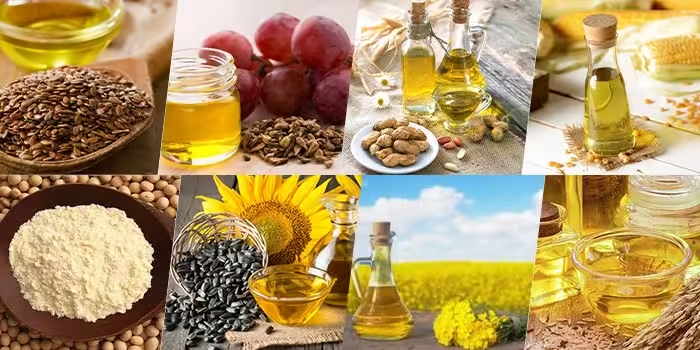
Applications of Refined Edible Oil
Refined oil is widely used in:
- Household cooking and frying
- Industrial food processing
- Snack and bakery manufacturing
- Cosmetics and pharmaceuticals
- Specialty chemical production
The quality requirements vary depending on the application, underscoring the need for a well-engineered refining system.
Conclusion
A modern edible oil refining system is essential for producing safe, stable, and high-quality edible oils that meet global standards. Each stage—degumming, neutralization, bleaching, deodorization, dewaxing, and polishing—must operate under strict control to ensure product stability and economic efficiency. With advanced equipment, automation, and energy-saving technologies, manufacturers can improve product quality, reduce operating costs, and enhance production reliability. A properly designed refining line is fundamental to long-term success in the edible oil industry.
FAQ
What is the primary goal of edible oil refining?
To remove impurities from crude oil and produce clear, stable, food-grade edible oil.
Which oils require dewaxing?
Oils such as sunflower and corn germ that contain natural waxes and become cloudy at low temperatures.
Is physical refining always better?
Physical refining is more efficient for low-phospholipid oils, but chemical refining is still preferred for oils with higher impurity content.
How can refining efficiency be improved?
By controlling moisture, temperature, vacuum level, clay dosage, and crude oil quality.
What equipment is most crucial in a refining system?
The deodorization tower, as it determines final flavor, stability, and safety properties.